Yeah it is a lot more powerful for sure. Really bad for the environment though.
Having gone from a 120 to 240v Grainfather, I can empirically tell you you are wrong. There is a very noticeable difference.
This thread surfaced while I had been ruminating over giving away my propane burner (used a couple times, not in the last five years), 8-gallon kettle (not used as often as my 5-gallon because the 8-gallon is so heavy), and 9-gallon cooler mash tun. I’ve used my Mash and Boil twice and it really sells itself. All together, it’s a lot less fuss for my 3-gallon no-sparge batches, in a much more compact footprint. The only physical challenge is lifting the basket post-mash, and I got a rowing machine last month to diversify my workouts so perhaps in a while I’ll have the “guns” for that not to be as much of a problem. 
Oddly the piece I would find it most difficult to part with is the cooler, maybe because I associate it with the magic of mashing and the delicious bready fragrance that would hit my face as I opened it every few minutes to stir the mash – even though lugging it around post-mash, getting the spent grain out, and then washing it is not something I miss at all, and I certainly still enjoy the mash in my AIO. There’s no rush for me to divest of all this stuff, but there may be a point at which it would be hard to find takers, even as giveaways.
I wonder if the “recruitment” phase for new homebrewers will continue to be the traditional kit many of us started with (I picked up the hobby 12 years ago), and also what the “retention” phase will look like. Cost-wise an AIO is a higher level of entry, but then again there are no $85 rowing machines either. And if you do need to brew outside on a propane burner and don’t happen to own a large kettle, the cost differential gets even smaller.
I don’t know that propane is going to become a relic but it’s definitely moving out of being at the forefront of brewing. For less than ten gallon batches I can’t see brewers opting for the cooler/burner setup when they could buy the increasingly cheaper electric systems. A lot of brewers are regularly brewing smaller than five gallon batches which makes stovetop brewing accessible even on an electric stove. Alternatively, for brewers of those fifteen or twenty gallon batches I think we are a long way off from an electric option at an affordable cost.
I am generally a smaller batch brewer with a gas stove which means I can do my usual 1-3 gallon batches indoors. I have a burner but in almost twelve years of brewing I’d be surprised if I have used it more than twenty times. I think I’ve filled my propane tank twice and it ran out the second time four or five years ago without a refill. I plan to get some new blending projects going which will need the firepower of a burner but it will probably go another five years before it gets refilled.
For me, currently, a dedicated 220V is out of the question so for anything larger than 6-7 gallons it’s gonna be propane.
The major problem with TSP is the phosphate component. It can cause algae blooms if it ends up in rivers and lakes. That is the reason why phosphates were removed from detergents. However, the phosphate argument is moot when one is on septic, as the effluent is drained into one’s drain field, which is usually covered by grass. Phosphates are great for root growth. TSP is less dangerous to a septic tank than chlorine bleach. If we want to talk about a toxic compound, then sodium metasilicate is up there. That is the main ingredient that separates PBW from Oxyclean. It is also what is sold as TSP/90 and TSP PF, which are both TSP substitutes.
In practice, the amount of TSP used to clean home brewing equipment is quite small. We are talking about one to two tablespoons per five gallons of water. The major problem with TSP in a home brewery is the pH, which is 12, making it almost as caustic as pure sodium hydroxide, which has a pH of 14. While not mandatory, gloves prevent TSP solution from drying out one’s hands.
Believe it or not, there are brewery cleaning products that contain TSP. For example, the reason why Craft Meister Keg & Carboy Cleaning Tablets clean so well is because they contain TSP (https://www.google.com/url?sa=t&rct=j&q=&esrc=s&source=web&cd=&ved=2ahUKEwjz8ZiRvKPuAhVDjlkKHTGJBXcQFjABegQIBRAC&url=https%3A%2F%2Fwww.nationalchemicals.com%2Fwp-content%2Fuploads%2F2020%2F05%2FSDS-CM-Keg-Carboy-Tab-7_16.pdf&usg=AOvVaw1ezF8yipjW3ASaBF6X5MvD). My first use of TSP was to clean soda kegs. Back in the early nineties, there was a guy out of Minnesota that sold used soda kegs and kegging systems (that was before soda kegs and kegging systems were sold by most LBHS). He recommended CTSP for cleaning kegs. CTSP is chlorinated TSP. CTSP cleans and sanitizes in one step. It may not be the best choice for sanitizing stainless steel, but it works like a charm. It will absolutely render the nastiest, soda has been sitting in it for years used soda keg spotless.
Wildly changing the subject here but for homebrew stuff regular old oxiclean works for me for what I have. Commercial brewing caustic and acids. I have used a product called “Brewer’s Ease” in a commercial setting that may have has TSP not sure - it was powdered like PBW and it worked amazing.
I went electric a few years ago and it was what kept me brewing. In Minnesota, brewing outside in the middle of winter was killing me. Now, it’s just walk downstairs and it’s 68-72 year round. Spent some money to do it, but I wonder if I would still be brewing if I was carrying everything out to the garage and freezing for 5+ hours.
I’m using exposed elements and so far I just give it an annual clean and a spray after every brew. I haven’t noticed any problems with off flavors at this point in time. However, I’m doing about 12 batches per year so I’m not working it overtime.
Good discussion and shows how much this hobby has evolved.
I am not saying that there is not a noticeable difference. Going from 2000W or 2400W to 3500W is also a noticeable difference. What I am saying is that to require 240VAC service for a 2000W device is a missed opportunity here in the United States because the average kitchen circuit can provide that much power on a 120VAC circuit. If one inspects one’s breaker box, there should be a circuit labeled “kitchen countertop” or “kitchen outlets.” More often than not, the breaker will have a value of “20” on it. Unless some nutcase installed a 20A breaker on a 14-gauge wire run, that means that the circuit was run with 12-gauge wire. Twelve-gauge wire can carry 20A of electricity, which means that it is capable of handling devices that require up to 120 * 20 = 2400W of power. The reason why kitchen circuits are 20A is so that more than one appliance can be operated at the same time. The receptacles on a kitchen circuit are usually NEMA 5-15, which are 120VAC/15A receptacles. However, they all have a pass-through current rating of 20A, even the GFCI outlet. What this means is that one can replace a NEMA 5-15R duplex receptacle with a NEMA 5-20R duplex receptacle in order to accommodate the NEMA 5-20P plug, which has one of the blades at 90 degrees to the other blade. One can tell a NEMA 5-20R receptacle from a NEMA 5-15R receptacle because one of the blade holes on the receptacle is a “T.” This configuration allows a NEMA 5-20R receptacle to accept NEMA 5-15P and NEMA 5-20P plugs. In many jurisdictions, NEMA 5-20R receptacles are code on a kitchen circuit.
NEMA 5-15R 120VAC/15A
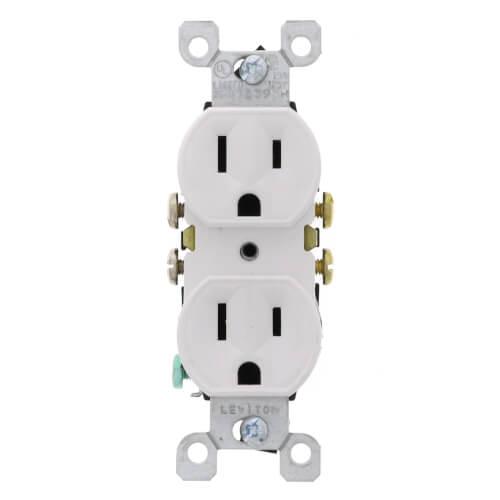
NEMA 5-20R 120VAC/20A

By the way, the first number denotes the supply voltage and pin-out. A number of “5” means 120VAC hot, neutral, and protective ground. A number of “6” denotes 240VAC hot, hot, and protective ground (e.g., a NEMA 6-20R socket has hot, hot, and protective ground)
NEMA 6-20R

Please note that this socket also has a “T” blade hole. That is so that it can accept NEMA 6-15P (240VAC/15A) plugs that have two horizontal blades.
The element size was part of the reason that I went with the Anvil Foundry.
Features:
Switchable Between 120V 1600W and 240V 2800W for Faster Heating & Better Boils.
I do have an electric 18 gallon electric BIAB set up from Stout Tanks fitted with 240V/5500W element for larger batches.
That is a good compromise between 120VAC and 240VAC operation. A 2800W unit would require a NEMA 5-30 120V/30A circuit, which is quite rare in the United States. A NEMA 5-30 circuit requires 10-gauge wire and can provide up to 3600W of power. One can obtain 4800W on NEMA 6-20 circuit using 12-gauge wire and standard size simplex or duplex sockets. Not only is 12-gauge wire cheaper than 10-gause wire, a NEMA 5-30R receptacle is more than twice as expensive as a NEMA 6-20R receptacle.
As far as electric brewing goes, it started to gain traction with 20-gallon kettle-based setups. An AIO setup gets to be tricky with larger batches due to the weight of the grain, but if we are talking about traditional 2 or 3 vessel setups, the additional cost to go from 5-gallon batches to 20-gallon batches from a controlled heating source point of view is not huge. The only real differences other that kettles are the element(s) and SSR(s). The same PID came be used for both setups.