As Jonathan already mentioned, you do not have to do a thing to cropped yeast in order to be able to re-pitch it. Brewers have cropped and re-pitched yeast (barm) for millennia without rinsing it with boiled water. In fact, all of the non-wild brewing cultures that we use today are the result of continuous cropping, especially true top-cropping strains. If one finds a true top-cropper in a container of wort that was known to be absolutely sterile when placed outdoors, one can pretty much be assured that the yeast strain was left behind by another human.
This technique is used by every truly experienced brewer that I know.
true. I’ve found with mason jars with the two piece lid if too much pressure builds up the seal fails before the bottle but better safe than sorry.
I always seal “fingertip tight”
+1. The two piece lid definitely needs to be on loose.
Which is why I store cropped yeast in 500ml Erlenmeyer flasks with #7 stoppers and airlocks. A six-pack of Corning 4980 500ml Erlenmeyer flasks can be had for $25.25 shipped. That’s $4.21 per flask. My oldest Corning 4980-500 is over twenty years old.
www.amazon.com/gp/offer-listing/B004XR5V0A/ref=dp_olp_new?ie=UTF8&condition=new
If it’s thick, and I have siphoned most of the beer out of the fermenter, I will pour in a can of cheap swill like PBR (funny that I always seem to have cans of that lying around), then follow the rest of what Denny said.
Denny too, would you say using flasks or mason jars are better? Also how would you recommend sanitizing them?
Can you define your entire process for us S? Ill try it, the only reason i was rinsing is because it was the most used method i could find instructions for.
And please pretend, for at least some of us, that our microbiology education stopped at high school bio.
+1. I’m curious too. I feel like I’m always on here asking naive, bone headed questions, but sometimes details that are obvious to you aren’t at all obvious to a relatively new brewer who has been teaching himself from books and the internet.
One particular piece of this puzzle that drives me bat sh*t crazy is the question of what you guys do with all the break and fine dust from pellet hops when it comes to transferring from the kettle to the fermenter, and again when cropping yeast. I’m starting to conclude that I’m being too dramatic trying to get clear wort out of the kettle. I use hop bags to help me keep most of the pellet hop sludge out of the beer, but after the boil I still have quite a bit of break and fine hop dust left. I’ve wasted quite a bit of beer trying to leave this stuff behind.
Then I read that guys like KlickitatJim put all their hops in commando, and it sounds to me like anything the whirlpool doesn’t drop out goes unceremoniously into the kettle guts, feathers, and all. Same for cropping yeast-- just swirl up all the crap in the bottom of the bucket and don’t sweat what’s in there. Do I really have that right?
you got it. barley wants to be beer. we just have to help it along a bit.
I think that at least for me it’s a combination of laziness and effectiveness. It’s the easiest thing to do and it works as well as anything else I’ve tried.
IMO, neither. My LHBS sells bulk extract in 1/2 gal. plastic tubs with snap on lids. I buy a few of them and use them for yeast storage. They’re unbreakable and the lids will just pop up a bit if too much pressure builds. I’ve been using them for 10+ years with no problems at all. I sanitize with StarSan.
Yep, that’s exactly what I do. When I use whole hops, I use a bag so they don’t go into the fermenter, but all the other trub does. When I use pellets they go in lose, go through the pump and into the fermenter. when I reuse the yeast they’re still on there. It just doesn’t matter.
If it’s simpler and produces good results…then it’s a viable process in my book. I’ve made dozens of beers using this technique with very good results.
I use sanitized 2L soda bottles.
I use anything from plastic bags in Tupperware containers to mason jars to plastic tea or juice containers to wide mouth 2000ml Erlenmeyer flasks with a foil covering (all sanitized, of course), but my favorite is no container at all. I time my racking from primary to coincide with my brewing day, so I just swirl and pour from a primary into oxygenated, chilled wort that is waiting for the pitch in another primary fermenter. No muss, no fuss. Of course don’t pitch it all! Half of the slurry for lagers and a third for ales, if it is pretty fresh (less than a month or so in the primary).
Watch the number of generations, but I have gone over 20 generations with WLP 800 without incident (I just wanted to try new yeast for my standby lager).
I have used both types of containers, and I prefer to use flasks if they are available. Using Mason jars became standard practice back in the early days of brewing because lab glassware was difficult to obtain. Scientific equipment suppliers only shipped to labs. The use of baby food jars for making slants and small volumes of canned sterile wort was also part of the “make do with what you can get” early amateur brewing culture. I used recycled, de-labeled 4oz baby food jars for autoclaving solid and liquid culturing media during my first ten years in the hobby. I now use Corning 1395-100 100ml Pyrex media bottles, and I would never go back to using baby food jars.
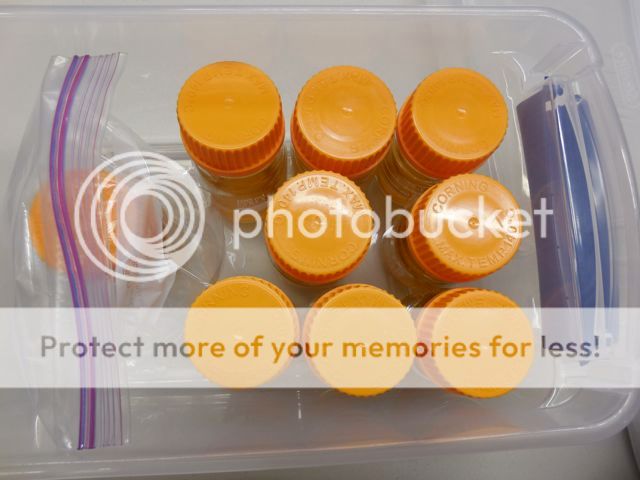

My bottom cropping technique is outlined in paragraph number four of the original post in this thread. It’s basically the same technique that Denny uses with a couple of twists.
As I mentioned earlier in response to Denny’s post, the core bottom cropping technique that Denny and I use is used by almost all experienced amateur brewers that I know. We have been cropping this way for so long that we can hold a conversation and do it at the same time without spilling any of the crop.
One habit that all brewers should get into is the habit of wiping all pouring surfaces with a cotton ball soaked with 95% ethanol (or 91% isopropyl alcohol if one is patient enough to allow it to flash off) before decanting any yeast culture (that includes starters and all steps in the starter process). The pouring surface of a container holding a yeast culture should always be treated like it is contaminated. Just as a nurse or doctor disinfects one’s skin before injecting one with a syringe to ensure that the needle does not drag surface bacteria into the injection site, wiping the pouring surface of a container that contains a yeast culture prevents the yeast culture from dragging any wild microflora that may be resting on the pouring surface into fresh media or wort. It’s a cheap insurance policy.