UPDATE
72 hours. 50.2% AA, pH 4.23, allowing free rise to 70°F ambient.
+1 on sampling, but also just ease of transfer.
With a brew bucket, I have option of using a ball valve, but then having to close the valve and just be satisfied with cleaning the exterior of the valve as best I can. Not to mention having to lift the fermenter to accomplish any of this.
With the glass carboy I have the option of inserting a thief into the beer to draw a sample. Have to open the fermenter to accomplish this.
With a plastic bucket I have the option to open a very large area to use the thief or use a spigot… same issues as the brew bucket with that.
Transfering to a keg should be just as easy as sampling. In the event a spunding window is missed, I have to belief this option would introduce less o2 than my current transfer operation from a glass carboy.
I’ve been greatly enjoying the ease of sampling and transfer, as well as peace of mind, since switching to ball lock fitted fermenters even when fermenting at atmospheric pressure. Before the 10 gallon corny, for a time I used a Speidel that I had customized with ball lock in and out posts, and used the same improvised airlock as I had on the corny until now. BTW this is another way I know that 7.5 gallons is plenty to ferment 6 gallons without fouling the gas post at the top of the vessel, which should reassure you, JT. My horror at the prospect of maintaining sanitary conditions with a ball valve is why I have been determined for some time to find a corny-like solution rather than a typical conical. Turns out a corny is pretty corny-like.
That’s why I want to get Chris’s chart. Wide variety of results depending on yeast strain, temp and pressure.
I look forward to the chart, Denny, because with the new genome information that keeps coming out, it will compliment the knowledge base nicely to know the pressure effects of these various sugar fungi that we had so many preconceptions and misconceptions about in our prior classification system…
4 days. 64.0% AA, pH 4.24. Has risen only to 66°F, activity seems to have wound down but yeast not heavily flocculating yet. Was expecting 69-70% AA, will continue to monitor.
UPDATE
6 days. No further attenuation, yeast dropped. So, somewhat underattenuated, but ultimately finished in the same time as a batch at atmospheric pressure would be expected to. (It is not out of the realm of possibility that some, but I think not all, of the underattenuation could be accounted for by a slightly higher mash pH – an international adjustment – than the previous batch of a nearly identical beer used as a reference.) I have a feeling that if I plotted enough data, the attenuation on this pressurized batch would look more like a straight slope than the right half of a bell we’re used to. Whatever that means. So I’ll crash this and rack it in a few days. SOP is a couple weeks at least “lagering” at 30°F before a couple weeks in the keezer carbonating. When I taste it I’ll report. Meanwhile I’ll brew again next weekend. I plan to pressure ferment that batch, but at a higher temperature throughout. I’ll report progress on that here as well.
Cool; I’ll look forward to hearing how the next batch goes.
I haven’t used S-04 for a while, but 64% AA seems pretty low, right?
I’ve got a Tripel finishing up fermentation now in a 10 gallon corny keg with spunding valve attached. It seems to be generating about 4 psi every 12 hours (when it gets to 5, I manually bleed it back to 1).
64% isn’t out of the normal range for S-04 IME, depending on the recipe. It sometimes is described as attenuative, but it’s still English, doesn’t eat maltotriose, etc. It is lower attenuation than I expected for this beer based on 69.7% (IIRC) for a previous, nearly identical, recipe. But this is just one batch, one data point, could be a fluke, or not. But I’ll say one thing – I detect no flavors that need cleaning up whatsoever. It hit final gravity ready to crash cool. So the method may save time, and I’m confident about fermenting the next one warmer to see if that speeds it up in the early stages and gets it to attenuate further. Pressure fermentation so far has fulfilled all my other expectations as far as convenience, easy sampling, peace of mind about oxygen exclusion, etc. I plan to make this my standard practice, I just have to learn what adjustments I’ll have to make in recipes and timetables. And get the hang of the PRV a little better.
I submitted the following query on both Lallemand’s and Fermentis’ websites. (The wet guys’ websites don’t seem to offer a way to submit technical questions, and I’m keen on dry yeast lately anyway.) I’ll post any replies I receive.
“I am a homebrewer switching to a new system, fermenting under 5-6 psig head pressure. What considerations should I be aware of regarding yeast performance? Should I alter fermentation temperature or pitching rate? Are there differences in suitability to these conditions among strains? Thank you in advance.”
Good call. Interested in the responses. Great thread topic, btw.
They’ll get back with you pretty quickly. I’ve sent questions and received answers right away.
^^^^
Indeed! Already got this, from the guy I was in communication with on a previous thread:
Hi Robert,
Thank you for contacting Fermentis. A head pressure of 5-6 psi (head pressure) will not have a big impact in the behavior of the strains. Studies in the past demonstrate for lager strains that over 15psi and mainly over 26 psi you could have a reduction in the esters production but with 5-6 psi is business as usual.
Thank you,
José PIZARRO
Just what I was gonna say!
Robert, how are you serving the beers you are pressure fermenting? I’m transferring to a corny, using the Tilt to ballpark SG prior to the transfer. Are you keeping everything in the 10 gallon corny?
Looking forward to this Best Bitter.
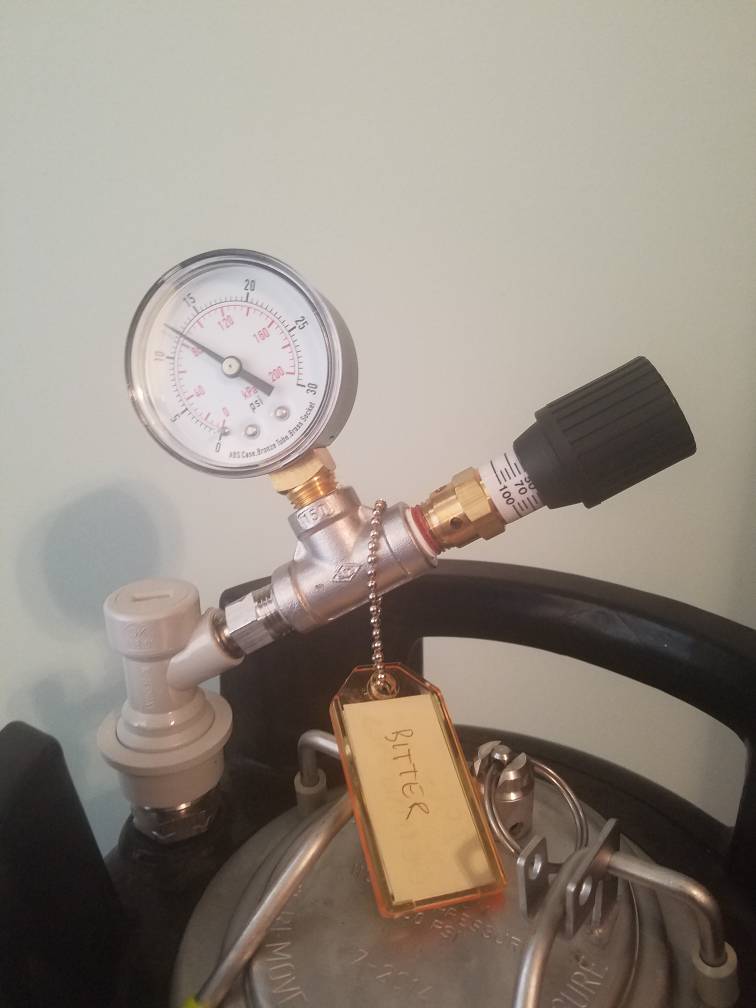
I’m not currently changing anything but replacing the airlock with the PRV. Current SOP is to ferment to completion in the fermenter, rack to serving keg (which I just did with this batch,) then a couple of weeks or so lagering at 30°F (fined or not as I see fit,) then into the keezer to carbonate at serving pressure and temperature before tapping.
BTW planning the next pressure fermented batch right now. Think I’ll do a tweak of a really enjoyable one from a few months ago I want to revisit. Just pale malt and Invert, and Nottingham. I’ll follow the same mash and fermentation temperatures, since Fermentis says no adjustment is needed, and see if it gets something like the 76.7% AA it did before. I’m thinking, regarding this last, slightly underattenuated batch, a) IME S-04 isn’t really all that attenuative (manufacturer cites 75% in laboratory conditions) and b) the variation from my reference batch is not all that informative. Probably enough variables that any effects of pressure can’t be teased out of the noise.
(Edited for omitted words.)
Received this reply from Lallemand:
Hi Robert,
All of our brewing strains can effectively bottle condition, which gets to around 30 psi. I don’t expect that you will have any problems fermenting at 5-6 psi. You should be fine using a standard pitch rate between 0.5-1.0g/L for most ale strains. If you are brewing a higher gravity beer than pitch on the higher side.
I would appreciate your feedback though, please let me know how it turns out!
Cheers,
Eric
Eric Abbott, M.Sc.
I’ve been trying to analyze my records on a number (8) of recent batches using S-04. Average AA is 69.8%. Eliminating the high and low it is 69.5%. 4 of the remaining 6 batches are right about on that average. The highest of that group is 72.2%, the lowest is 66.4%. The outliers in the 8 are this 64% batch, which is still closer to the average than the other end, 77.7%, a true anomaly. So I really don’t think there is any inference to be drawn from the attenuation of this batch, related to pressure or anything else for that matter. I also fail to draw any correlation between attenuation and either mash program (which varies very little in my brewery) or mash or wort pH across the whole set. I must conclude that materials and formulations are surely the most important variables.
I propose that the suspected underattenuation of this batch cannot be confirmed by the data, and that my first pressure fermentation is consistent with confirming the yeast manufacturers’ assertions that this level of pressure has no effect on fermentation. I will of course continue to report results on the next few batches, and hope that anyone else trying this will also contribute their data in this thread.
Beware (from what I understand) that fermenting under pressure can result in underattenuation and increased diacetyl/acetaldehyde production. Harvesting yeast from this and repitching can also lead to issues over time.
Do you have any references for this? I’d appreciate any information.