Very few of the yeast strains available via the home brewing trade benefit from using pure oxygen. Where pure oxygen shows its strength is with class O3 and O4 yeast strains (i.e., yeast strains whose oxygen demand cannot be met by air saturated wort). We are talking about mostly Yorkshire-type yeast strains, but brewers have figured out how to use regular air aeration with these strains by spraying actively fermenting wort down onto itself using a fishtail spreader. The problem with using a diffusion stone is keeping it clean and sanitary. I used to boil my diffusion stone before I gave up on using it. Cleaning sanitizing a venturi-based aerator is about as simple as it gets, which is why I went back to using one after playing with pure oxygen.
I’m not a microbiologist. Just a brewer. The logic I am going on is that you want 10 ppm of DO for ales and ~15 ppm for lagers. My understanding is that this helps the yeast strengthen cell walls since the glycogen reserves have been depleted in storage. I have been in the pro-brewery field for 10+ years now and I’m just getting back into the homebrewing scene again. If that information has changed then cool, that’s not what most commercial breweries or homebrewers are basing their current practices on. The brewery I am working at now the head brewer is still aerating dry yeast. I told him it wasn’t necessary but, hey. Old habits. (He’ll listen to me eventually since I trained him originally, lol)
What I will say is that my brewing improved years ago when I started adding adequate aeration for yeast pitches. Compressed/filtered air made that process easier and less time consuming and using pure 02 made it even easier still.
Most likely I will continue to use that approach.
i don’t brew during the summer, but come fall i believe i will try this venturi method of oxygenation.
just truth be told my wort chiller is homemade, and i am usually too lazy to chill my wort under ~45-50C, and just figure that is cool enough to let it cool by itself in the sealed carboy overnight. so i might do a long-time planned upgrade to my wort chiller to allow it to cool it down before using this. in any case it saves me from spending ~75-100 dollars on an o2 tank and oxygen diffuser.
I used a venturi for years, then switched to an O2 system. I didn’t notice much difference with either compared to just pumping or dumping wort into fermenter. Got rid of both of them.
The guys over at the low oxygen forum have done a bunch of measurements with pure O2 and a DO meter. It definitely works. But I’m sure other methods work just fine too.
Yeah, I boil mine for 10 minutes before every use. I don’t know if it’s really necessary, but it does the trick.
To sani mine I bring a pint of water to a boil, turn off the heat and soak the stone while I prepare. Then I sanitize soak everything. I aerate, and hot soak it again. Occasionally I may boil the whole thing. I store the entire contraption in a gallon ziplock bag once it is dry. Super simple and never has it been a problem.
I started using the Blichmann In Line Oxygenation Kit a few brews ago, and I’m very happy with it…
I used the wand oxygenator, and it was useful - but I think the in line kit is more effective. I feel that more of the wort comes in contact with the stone, and more O2 is absorbed - or at least more evenly distobuted though the fermentor.
I agree with you on this one.
I used Venturi tube in commercial brewing for years. I triple batched and I did not have problem at all. As a matter of fact I did 65 generations on the same yeast.
Then I bought a new brewhouse and I only single batch to the fermenter. After some time my yeast just got tired and died. I could not even do 5-6 generations.
Finally I bought inline oxygenation stone. I have Blickmen oxygen regulator and pretty much fallow dosing instructions (1 liter/min oxygen for 10 gallons/min wort) now all is good again.
As far as keeping stone clean. When I do not brew, it lives its life in caustic solution. On brew day after good rinse it spends a couple of hours in sanitizer.
So there you go. It depends on your equipment and process.
In line is definitely the way to go but you have to have the wort cool enough for it to be effective. For homebrew my wort very often not cool when I am racking to the fermenter and it takes several hours until it is cool enough to aerate and pitch yeast. So inline wouldn’t work.
Major - are you saying that the wort must be chilled to pitch temperature to adequately absorb oxygen into the liquid through inline injection, for however transitory that may be? If so, could lagers be racked at ale temps and oxygenated inline to the fermenter, then allowed to cool down to fermentation temps without concern about oxygen remaining sufficient? Just wondering about the dynamics here - does the oxygen stay in the wort as it cools to its ultimate fermentation temp or is it “driven out” by the cooling process or absorbed by the yeast scavenging or both?
I have been using a wine de-gassing stirrer for batches that are re-pitches and liquid pitches - it gets pretty frothy and the yeast seem to make fast work of absorption/uptake. My last lager was re-pitched into 64F wort (as cool as I could get it by immersion chilling in 90F+ ambient temps last Saturday). It was racing within 4 hours and fermented at 58F for five days and completed well attenuated (1.040 to 1.005)…I can’t imagine that it “needed” O2 by inline injection, but I have a stone that I haven’t used in a few years, because the wine whip seems adequate (all my beers are pretty low OG, though). I may just revisit O2 injection.
I oxygenate whenever I use liquid pitches. Never done a side-by-side, but way back when, as I was learning and trying new things, the two biggest jumps in quality for my beers happened when I started making starters and oxygenating the wort. Oxygenation can also help compensate for sub-optimal yeast health, and so it’s also an insurance policy that is worth the effort to me. I’m firmly in the pro-oxygenation camp for liquid pitches.
It should be done right at pitch time. O2 is not very soluble in liquid. If the O2 concentration in the wort is above the atmospheric concentration (~8ppm IIRC), the O2 is going to want to gas off to reach equilibrium. If you wait a long time to pitch after oxygenating, you’re probably not realizing the full benefit of the >8ppm O2.
I put my O2 wand in the kettle I use to heat up the sparge water. Effectively sterile once it hits 160F. No need to boil or chemically sanitize it. In fact, you’re wasting time with chemical sanitizing because there’s no way liquid is going to get into those pores.
I try to pitch soon after aeration for the reasons RC mentions. But I don’t know how long it takes for wort to “degas” of o2. I imagine it takes longer than a few hours, but I do think it is important to get them close. As far as the degassers go, I have never used that but obviously it works because so many people use it.
I have never used in line aeration on homebrew unless you count the venturi pump I used years ago. But I have used them commercially. I brewed tonight on a pretty sweet Premier Stainless 20 bbl. But it doesn’t have a cold liquor tank and the ground water here in the south is pretty damn warm. For a reasonable heat exchange vs pump speed I couldn’t get the wort below 95 – at the end I was ready to go and speeded up the pump and hit temps of 107. No need inline aerating at those temps IMO. Best to just aerate the tank in the morning after cooled to temps before pitching.
Actually liquid goes right through those pores… even the 0.5 micron ones.
Actually, no. You’ll get some minor entry of water at the hydrostatic pressures typical of homebrewing, but very little. It’s easy to test for yourself. You’ll need some extra pressure to get a liquid cleanser or sanitizer to permeate all those pores.
The water wicks right into the pores. Just because it does not flow though without pressure does not mean they are not filled. If you are trusting this as a method to keep the stone contamination free… you are foolish.
Just the opposite. I don’t trust it. That’s why I pasteurize. Like I said, it’s easy to test for yourself.
When I use the word “sterile” with respect to yeast, I am referring to absolutely sterile, which means complete absence of life, including spores. For the truly anal brewers among us without access to a pressure cooker that can reach 15 psi above sea level atmospheric pressure (a lot of European-made pressure cookers can only reach 13 psi, so processing time are increased), boiling the stone three days in a row (Tyndallization) renders it absolutely sterile. The flash Pasteurization temperature of 160F is for vegetative cells only, but should be good enough for brewing because wort is not absolutely sterile.
I have linked Brian Kirsop’s seminal publication on oxygen demand in brewery fermentation below. It is where the oxygen demand classes O1 through O4 were originally defined. One encounters this nomenclature on a regular basis in the large culture collections. The most popular yeast cultures in amateur brewing are low-oxygen demand strains. The higher O2 demand cultures have been weeded from the home brew market. The word “forgiving” is almost a surefire sign that a culture is class O1 (4ppm dissolved oxygen).
Oxygen in Brewery Fermentation
https://onlinelibrary.wiley.com/doi/pdf/10.1002/j.2050-0416.1974.tb03614.x
For example, here is the description of NCYC 1333, which is a class O3/O4 Yorkshire culture that I used to have in my old bank:
Information Flocculent. O3/O4. Head forming Yorkshire Stone Square type recommended for bottled Pale ale.
Depositor British Brewery
Deposit Name Saccharomyces cerevisiae
Month of deposit January
Deposit Year 1974
Ale production strain Yorkshire Stone Square type recommended for bottled Pale ale.
Here is the glass vial in which the culture was shipped on slope (slant to us).

Here is what the culture looks like in use:
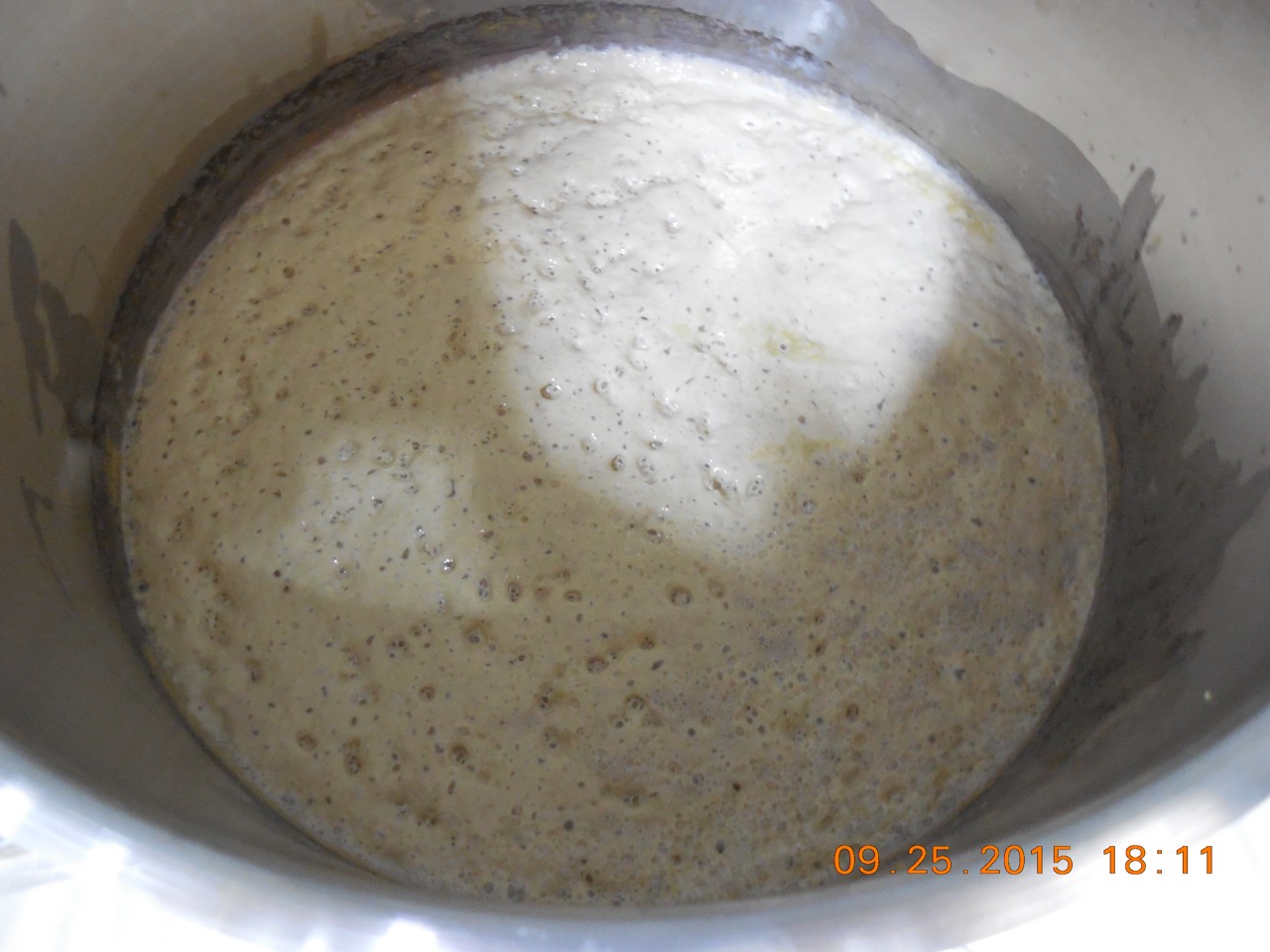
The culture flocs to the top and looks like pancake batter. It has to be “beaten back” into the fermentation either via vigorous mixing or through the use of a fish tail spreader. The only culture that comes close to this one in the home or craft brewing markets is multi-strain Ringwood and that culture has traditionally only been available to Alan Pugsley-built breweries. NCYC 1333 produces beautiful bitters, but it can also be a cruel mistress to use because of its oxygen demand.
I have and that is why I store the stone in a 4% NaOh soln between uses. Always get some crud that soaks out.
Anyone else use one of these with an O2 bottle and a wand?