Which is I am assuming… single infused, late hopped, fermented with dry yeast, warmer?
Again thats totally fine, but nothing a real German brewery would do.
But in the spirit of RDWHAHB, I shall bow out of this… You guys do you.
You know what they say about assume…you are incorrect on all counts. And what I care about anyway is results, not process. If it tastes like a good German pils, I don’t care how I get there.
To hijack my own post, got busy and messed up the volume and ended up with 1.042 OG (which probably gives me a 3.5 abv). Anyone else brew a Hef like this before? My concern is that it’s going to be watery.
^^^^
Palmer and Kaminski address, slightly nearer the level of most of our heads, how chalk dissolved this way is very unstable in solution. It is quick to precipitate back out, on its own or by apatite reactions in the mash, and is also very slow to adjust pH (taking several hours to have anything close to the expected effect, which is reversible.)
I think all of us lay people can get an idea of how hard it is to get carbonate into water and how easy to get it out, even when it was dissolved under the uneproducible natural conditions of very high CO2 pressure over geologic time: We all know that just bringing water to the boil does the trick. But even more illustrative is that a simple drop in pressure, as from line pressure to atmospheric pressure, will cause it to break out of solution. That’s how you get lime scale on a faucet. Surely I’d expect opening your 2 liter of Kai-style carbonated water would initate the process.
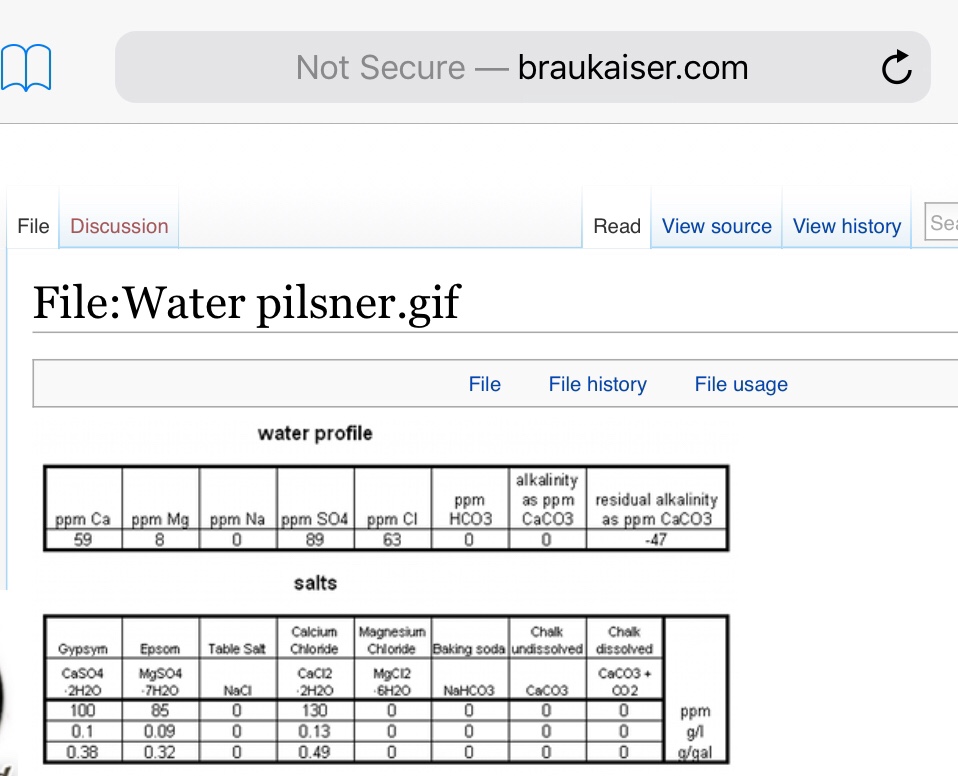
Many probably follow this advice: Sulfate and noble hops don’t tend to play well together, so calcium chloride (not much) to distilled water for a great pilsner. Many would say no gypsum for this reason. However, it looks like Kai is on the gypsum team for a Pils as well:
Interesting. Kai’s finished profile is very close to mine, as it stands at the moment, for pale lagers. I find sulfate desirable in just about any beer, as long as it’s somewhere under 100ppm. I’ve found I’m less tolerant of chloride. (And I’m not as scared of sodium as I was before letting experience replace dogma, I have a little more than Kai.) So gypsum will probably always have a place even with SMB contributing some potential sulfate, as I’m aiming for ~60ppm calcium. Palates will differ.
No blind triangles, not gonna do it. I’ve learned over time I don’t like anything in excess, but everything in moderation. As long as no single ion approaches 100 ppm I probably will find the water’s contribution balanced and unobtrusive. That’s either useless guidance, or the most helpful possible. It serves me as a guideline so I can concentrate on getting adequate calcium to satisfy the needs of the mash, which is IMHO all that really matters.
 The more you know.