Yes, Thanks Martin for the info. And to everyone else who offered help here.
I spent a couple hours last night attempting to correlate what I had done with early batches using the very early free version (I saw it said v1.4 in the spreadsheet I opened last night). I attempted to transfer info from those early batches, 1 5gal and 1 10gal, into the subscriber version I have used ever since. It wasn’t seamless, there were a few things that calculated slightly different. But it was pretty close.
I also saw variations in the free version water inputs vs the subscriber version inputs, indicating to me maybe I paid for 2 water reports back to back within the month where I tried the free version till I paid. But my saved emails do not indicate that. They were all-but-identical, but I don’t understand why they were not completely. For instance, 7.3 vs 7.0, 9 vs 10, ??? I did not take note of how many beers I had when I typed that stuff. Maybe that’s part of it.
Doing a quick search on my work PC today, I find that Martin sent me a new copy of Bru’nWater in 2018 which I’ve never used… So I looked at the email archive and yep, 10/7/18, there it is… Well, I wasn’t brewing then. I only brewed once in 2018 due to my work schedule 7daw, so that obviously got saved and tossed in my brewing files, email archive, and promptly forgotten. Not the end of the world, my earlier copy worked fine too.
So, I’m trying to go through old batch notes, brew day procedures and water adjustments, to better understand the cause and effect of some of these changes I’ve made. I can already see some correlations of taste notes and pH targets, and now starting to understand how some of my misconceptions affected the outcomes (good and bad). So things will definitely be different going forward. For better or worse. lol.
That’s a reasonable restatement. To bring sulfate levels up for hoppy beers, there’s only so much you can supply with Epsom Salt, so the rest does end up being via Gypsum. The Ca content is going to be high because of it. That’s not a detriment in those beer styles.
We can’t really control what precipitation reactions occur in the mash, kettle, and ferment, so I don’t worry what the endpoint is. I just concern myself with the starting concentrations that I do control.
I need to spend some time to (re-)familiarize myself with this new version of BrunWater. There’s a fairly steep learning curve when you have no background in chemistry and made several incorrect assumptions right from the start. Not to say it still hasn’t been a revelation, but I certainly haven’t gotten as much out of it as I could have if I had put in a little bit more time and effort.
Just today at work I read your article on Vienna lager and I wish I had read that before I just brewed one last sunday. LOL. I have no doubt the beer is going to be wonderful, but it definitely could have been better if I had known then, even the little bit I know now, about sulfate and chloride.
The lager I’m drinking this minute cleared beautifully and has about every characteristic I could ask for. Excepting I kind of wish it was a touch drier. But all in all, I’m pretty happy I’m down to splitting hairs on some of these beers. Cheers!
My IPAs are a lot better when I use leaf hops instead of pellet hops. Never can get great hop flavor when I use pellets - I thinks its my system, I have to use paint strainer bags to keep the pellets from clogging my screen. In the old days I used to just lift and pour the chilled wort into a fermenter through a colander, and got better hoppiness from pellets.
Yeah, I would have to say it’s the issue with your system. As you well know, I make a lot of IPA. If pellets weren’t giving me the results I wanted, I’d switch back. But that hasn’t happened. As a guess, I’d say 90% of commercial beer is brewed with pellets.
I’m not surprised that 90% of commercial breweries use pellets for brewing. Their many attributes (smallness of storage size, longevity, etc.) are undisputed.
Given all that, there has been has been a real decrease in the availability of leaf hops in the last 10 years. I used to be able to buy pounds of noble European leaf hops. Those days are gone forever.
To me, its akin to that I used to be able to enjoy the fat sounds of vinyl over tinny digital music. Or could have a really good phone conversation on a telephone instead of a smart phone or MS Teams. But I digress.
yes, that’s what im hoping for/working on and i am just trying to make 2, maybe 3 usable profiles i can know work:
-pale bitter
-pale or amber balanced
-dark and roasty
i want to use pale or amber balanced on any darkish beer even as long as roasted malts arent the centrepiece
it definitely comes down to personal taste in the end, and i aim to just get systems that work and are practical rather than 100% ideal
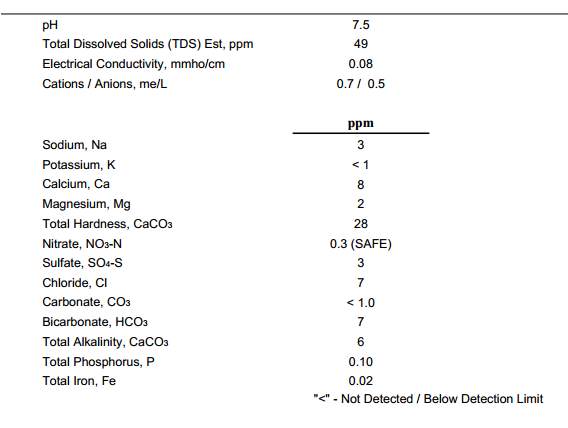
Yea, it’s a small town in rural PA. Water supply is filtered and all the lines in the town were replaced years back with all new. I even built some of the robots they used for sealing the joints with the UV cure epoxy that goes at every seam. Pretty cool. They’ve won nationwide awards for the water quality. I wish I had such at home but I live in an even smaller municipality (if that’s possible, lol). Here, I’m actually very close to the source water, but before any filtration plant used for the city, and I don’t even know if there is such a thing there. I live on a no outlet road and the reservoir is just up the road a bit, at the end of it. I’ve never had the water tested here. It’s nice, but if I don’t keep the water softener maintained, there’s stains in the toilets and sinks, so it’s pretty hard. At least compared to work.
I tried to post an image but life is too short to complete that… I don’t pay for a security certificate… It won’t even make a placeholder for an image now. tried ftp, that doesn’t work either…
Yea, I’ve tried 3 ways to ___ and back and it just doesn’t work without an httpS protocol. Ideally, the forum would just allow an upload where the server verified it’s an image and then the forum hosting hosts the image. That way, no matter what happens elsewhere on the internet, the image lives on. As it is with your flicker acct, if you close that, all the images you’ve ever posted here disappear. Which is why I advocate for any forum host to simply turn on the image/attachment uploads and host the ir own data. It’s literally the only thing this forum lacks. Open any forum here and click on the last pages (earliest historical posts) and you’ll be hard pressed to find ANY image that is still hosted, even on the recommended image host, tapatalk I think it is. (I’ve never used it).
But I digress…
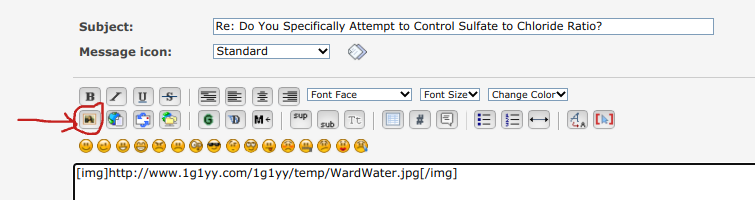
PS. Clicking that button doesn’t always even bring up the URL dialog box, and simply puts the IMG tags in the text editor where you have to formulate the entire markup manually. Then after numerous tries, all of the sudden it did ask for the URL and I was able to enter it. Weeks ago it also added an image placeholder where it had tags for width= and height=, but last night I could not get those to appear either. I tried to allow an ftp link, but I think my ftp has no anonymous access, so that wouldn’t work either… Most times I just don’t bother trying to add images because it’s so difficult. Then too it’s a challenge, ya get fighting with it and waste loads of time. lol.
I read Brewing Better Beer years ago and it liberated me from obsessing over grams scales, spreadsheets, and mineral salt additions. While it may be true that loading a beer with acids and salts may make the beer taste authentic, I’ve found the less I futz with it the better it tastes to me. I prefer ‘better’ vs ‘authentic’ taste. So, I don’t add a lot of salts.
The concept is simple: 1) use a consistent chlorine free water source. I prefer low mineral content. 2) focus on mash pH. Ensure there is at least 50 ppm calcium in the mash to aid in enzyme function. Withhold anything that can screw with pH until after conversion. 3) season to taste in the kettle using sodium, chloride, and/or sulfate. I rarely add additional salts.
As far as the critique I hear of withholding dark malts that screw with pH until after the mash has converted starch to sugar: I have found my validation. I entered an American Porter to the NHC 1st round at KC that scored a 42. I used Kurt Stock’s tried and true recipe as presented by Matthew Herrold at 2023 NHC and only changed the recipe by using the concepts above. I brewed a less robust version doing the same thing entering it as an English Porter in another competition and scored a 41. I knew these were both good beers and getting that anonymous feedback confirmed it for me: this works for me and anonymous judges.
One day, you’ll wake up and there won’t be anymore time to do the things you’ve always wanted to do. Don’t wait. Do it now.
We all have to do what works best for our brewhouse, for the beer and for our enjoyment of the hobby. Not necessarily in that order. I’m glad you found a water process that bangs out excellent beers consistently. Those scores are high praise indeed.
I’m quite happy making what I (and others) feel are very good beers simply by using my house well water and adding those grains that are beneficial for pH adjustment directly to the mash. No filtration and upkeep, no RO, no trips to the store etc. If I have to add a bit of lactic acid when I make a Cream Ale or yellow lager, so be it.
And I completely agree about measurements. I add salts by fractions of a teaspoon, however rounded. Good enough.
Maybe my beers actually suck and I’m fooling myself…and people are just being polite. Could be. But I’m enjoying the hobby.
I have no doubt there may be a point of diminishing returns, but all the same, I sort of enjoy working through the process. Yes, it can be frustrating, but imo that’s just part of it.
I listened to the 2 Beersmith podcasts where they had Marshall Schott from Brulosophy on, and after 160 experiments, the one thing they found more telling than any other aspect of beer making, was the water chemistry. According to him, far and away the most significant factor they’ve found. Virtually everything else had circumstances where the test panel was all but unable to detect the odd samples, but with water chemistry changes, the results were obvious. And this was counter to his original preconceptions that as long as the water wasn’t “Bad”, it would work. That was shown profoundly not true.
The other thing he said was noticeable was plastic fermenters vs glass. And it so happens that I did a batch 2 weeks ago in one glass and one plastic fermenter. There’s zero doubt, I can tell the difference, and it’s not even close. Not a matter of bad vs good, just VERY different. Which is quite educational to me. I’d never taken note of that before. I did another batch in just a plastic fermenter (for the first time) and that’s easily the best batch of that beer (4 batches) I’ve made yet. It’s always been done either in glass or stainless before. Pretty fascinating. He mentioned that he ferments exclusively in PET fermenters, but did his odd test batch in a carboy he was given years ago. The tasters could tell the difference.
You can make good beer without adjusting water minerals, but it’s luck of the draw what styles will work well with your water. I’ve lived in 5 states and traveled to quite a few more, and there’s no doubt in my mind I could pick out Oklahoma water vs. lower Alabama (or NoAla, Florida, etc, etc) water in a triangle test.
It’s like cooking without salt. Salt is (usually) a tiny fraction of a percentage by mass of any recipe, but no one is surprised when it makes a big difference in the final dish.
That leads me to a question about sulfate (but first some context):
In the 4-5 years I’ve been homebrewing, I have not [yet] done anything at all with water chemistry. I live in the north suburbs of Atlanta, near the Lake Lanier dam & water treatment facilities, and our water is reputedly quite good.
The first few years I ran all my water through a carbon filter, but then I tried just straight tap water and I couldn’t tell the difference. Beer was still good.
Then I started adding half a campden tablet to the tap water just in case (5gal batches), and while my recent beers have been slightly better, I’m not sure if that’s the campden-ated water or just my improved process/ability & recipes/ingredients.
For a hoppy beer, if I were to add a full campden tablet to my brew water (instead of my usual half tablet), I would have water with more sulfates, with little else changed, if I understand correctly. Is there any downside at those levels? 1 tablet per 7gallons is higher than needed for the chloramines, but still much lower than what winemakers and cidermakers use.
I may have to test that out on a hop-focused pale ale, if there’s no danger to it…