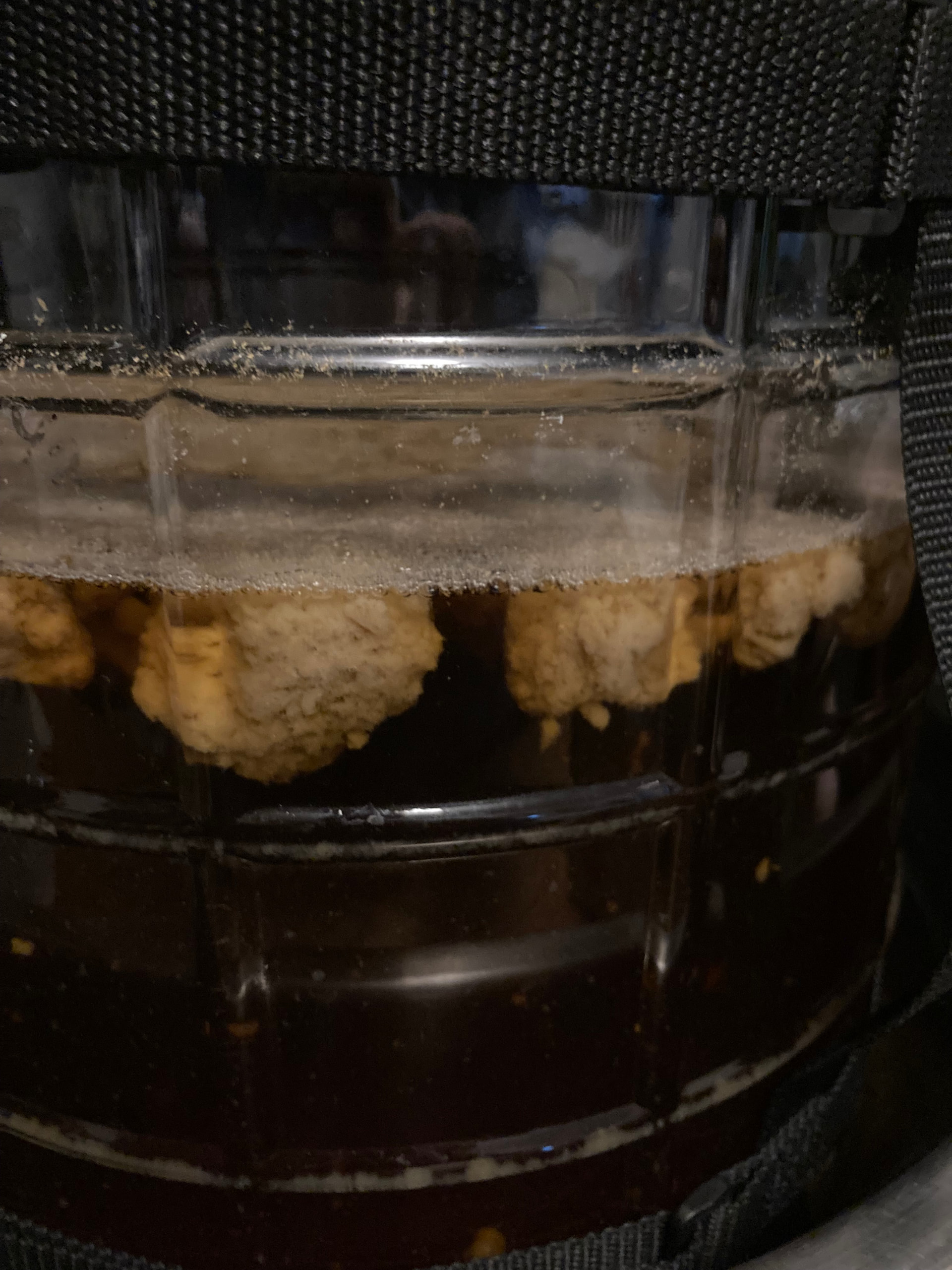
The batch was 20 liters of IPA. The water was boiled before mashing to remove chlorine. Pale ale and caramel malts were used. The mash was run for 30 minutes at 46°C, 30 minutes at 63°C, and 30 minutes at 70°C. The iodine test was satisfactory. 10 grams of calcium sulfate and 5 grams of magnesium sulfate were added throughout the process (the water hardness here is 45 ppm, pH 6.9, and alkalinity 36). The final pH in the mash was 6.2 (I couldn’t lower it with the sulfates). The boil was 70 minutes. 36 grams of hops were added at minute 10, 31 grams at minute 60, and 59 grams at the end of the boil. A whirlpool was performed. It was cooled in 20 minutes and inoculated with Safale US-05 yeast. A good krausen was observed during fermentation. An initial dry hopping was performed for 5 days. It was fermented for 15 days at room temperature (18.4 degrees Celsius here in Bogotá). The initial gravity was 1.064 and the final gravity was 1.024. It was then transferred to a Cornelius keg for 10 days of maturation at 3 degrees Celsius with another dry hopping in a stainless steel mesh bag.
If your bottled beer is clearer, it sounds like you need more time or a have lot of leftover yeast in the keg. Bottles have a shorter distance for it to flocculate out and you then pour from the top. Kegs serve from the bottom.
Hi Narvin. Your theory is good, but if that were the case, I would expect the first glasses to be cloudy and the rest to be clear. In my case, all the glasses I serve are cloudy.
The haze could be from tannins judging by your mash pH. If I had to make a guess why bottles are clearer, I’d guess that the smaller container settles more quickly.
I brewed my first stab at a Belgian Golden Strong at the beginning of February. A day or two before I brew, I collect my water, and circulate it for at least 12 hrs through my Mash & Brew (M&B) all-in-one kettle to remove the chlorine. I test the water with a BrewLab Basic kit to get a general idea of the chemistry. Because I’m on good city water, the only thing that ever changes much at all is the pH. I then use Bru’n Water to calculate my salt and acid additions to the mash & sparge water, which I separate before I mash-in, and adjust separately.
Well, this time, I inadvertently left the full volume in the M&B and mashed in. Because it’s not homebrewing if it’s not fun and an experiment, I said, “Oh, well. Here goes my first full-volume BIAB batch.” Gravity at the end of the mash was low, so I added some DME, but I miscalculated, and my OG was higher that expected. Oh well, the Golden Strong was destined to a Golden Extra Strong.
About two days after pitching, the gravity hadn’t changed. When I looked at the fermenter, I saw that rather than dispersing throughout the wort, the yeast had formed into small clumps, something I’ve never seen before. Thankfully, when I stirred the whole mess, the clumps broke up, and a few hours later the yeast got down to business.
Two weeks later, I primed and bottled the really tasty beer. Because I’m aiming for ~3.5 volumes CO2, it’s mostly in .5 L bottles, along with two 750 ml Andre Champagne screw tops. More on that when I open the first bottle in another two weeks.

Recipe:
9 lb 12 oz (71.4%) Château Pilsner Malt
1.4 lb (10.3%) Briess Pilsen Light DME
2 lb 2 oz (15.6%) Table Sugar
.5 oz Southern Star (13.3%) 60 min
.75 oz Saphir (3.5%) 15 min
1 tsp Irish Moss 10 min
1 pkg Safbrew Abbey Ale (Ferments BE-256) Pitched @ 61°F
Priming
3.3 g CBC-1 Yeast
6 oz Dextrose
Mash pH 5.29
Pre-boil Gravity 21.5°P (1.090 SG)
OG 23.8°P (1.100 SG)
FG 1.8°P (1.007 SG)
14 days active fermentation
Max temp. 75°F
I am definitely no Village Taphouse with the professional like photos and compositions
But here is a very recently tapped Irish red. Hazy due to 1318 and dryhops and it still has to condition but I am liking the dryness of the roasted barley. You can’t taste the roast but you can taste the dryness

Well not to split hairs but Pilsner Urquell is the only beer a Czech person would call a “Pilsner”

My latest attempt at a Helles with Jasper’s Munich lager and it’s… idk I’m conflicted. Great head retention!
Gorgeous head on that! Why do you feel conflicted about the beer?
You know I can’t put my finger on it. Last night when I had a glass it tasted almost too lactic, which gave it an almost juicy character? I’ve noticed that character in beers that I serve too cold (this one was served at lagering temperature, 32°F/0°C). I tried it this morning and that character was absent, and it was actually pretty nice, a solid 7.5/10. Perhaps my line wasn’t completely free of sani or something? I have no idea. I’ll try another 0,4L or so this afternoon and see if I’m full of it. I also have the same base wort brewed with the Jasper Urs Lager and that one definitely under-attenuated and oddly enough has far worse head retention. I’ll write up a comparison.
What a difference a couple of days has made
My Irish-American Red is grapefruity malty with a dry finish.
No ruby red grapefruits were harmed in the making of this beer
Still a bit hazy but I have been seriously venting to remove excess co2 from the keg. The condition is perfect now.

Interesting! Sometimes I find another tasting in different circumstances will help a beer taste way better than the first tasting. Maybe it’s just mood, serving temperature, a little extra gunk in the line, whatever.
Looking forward to seeing the comparison whenever you have it!

Split batch double decocted Helles Lager, 12.4°P approximately 21 IBU, Sauergut in the mash and acidified post boil with Lactic Acid. This one is fermented with Jasper Yeast’s Munich Lager, I think it fermented to dryness at about 2°P per the fast ferment but I haven’t verified that. I’m just gonna have to make a fair amount of Sauergut and use it all the way through because the pure lactic acid is a little slippery. Pretty good, dry and crisp but not without flavor. I don’t really notice the Saphir presence. Maybe a tad over carbonated but not too bad. I don’t think it’s winning best of show but I don’t think it needs to be turned into Radler or lawn food. To be clear I like it, but I had stupid high hopes for it and I think it juuuust doesn’t hit the mark I was trying to hit. I think it should have been filtered as well, this yeast is not as flocculent as I would have liked. But the head though…oooh dawggie!

Same split batch helles made with Jasper Yeast’s Urs Lager. Last night this was tasting sweet (a little too sweet) fruity with a raisin like character. Today it’s tasting far crisper (edit: as it warms up it’s pretty clear it’s not fully attenuated, bummer) but still with a nice, soft fruit nose and what my girlfriend finds a “Grassy” sweetness. By no means a bad or unwelcome character, and the clarity is absurd. This yeast is super flocculent. This one was not spunded and I think it suffered a little from being force carbonated. Especially in the head retention department. Still a pretty good beer!
As a lager boy I would travel to try that. Looks delicious!
‘24 Barleywine.
Fermented with 1318 and late hopped with Willamette and Cascade, went from 1.092 —-> 1.025, for about 8.8%. This was the first year I added a bit of Roasted Barley. I’m finding it helps combat sweetness and really helps with drinkability. Overall, a nice little sipper.
I did get a bit too aggressive with the pour however. I had one shot and panicked. 

Thank you

New Century Brown Ale came out a bit pale [edit: it looks darker in this pic. In person it’s closer to amber.]… but tasty nonetheless.
Crisp No19, Baird’s Crystal 60, Viking Light Chocolate. EKG @ FWH to about 25 IBU.

Tapped a Rye Stout. First time with this recipe (it’s loosely based on Denny’s BVIP).

It turned out really good, drier than expected which makes it very drinkable.
Rye Stout
4.4%
37 IBU
Mild Ale Malt
Flaked Rye
Pale Chocolate
Roasted Barley
Brown Malt
C55 & C120
Mash at 149F
Hops: Willamette
Yeast: US05